Two Neural Networks, One Conversation
It began with a simple idea: two different kinds of neural networks communicating with one another.
One is biological—the human brain, with its neurons, electrical impulses, memories, emotions, and experiences.
The other is artificial—a mathematical system trained to recognize patterns and generate responses.
They are not connected by wires, electrodes, or some mysterious force. Their bridge is language.
A human thinks, asks a question, and expresses an idea. Artificial intelligence processes those words and responds. The human interprets the response, perhaps changes direction, and asks another question.
Back and forth, the conversation develops.
But what happens when that conversation leads us somewhere neither participant anticipated?
That was the beginning of a much larger question.
What Happens When We Dream?
Anyone who has experienced a particularly vivid dream knows how convincing another reality can seem.
We meet people. We visit places. We experience events that sometimes appear completely logical until we awaken.
And occasionally, an idea emerges from sleep that we cannot remember consciously constructing.
Where did it come from?
Neuroscience offers several explanations. During sleep, the brain continues processing information, consolidating memories, and reorganizing associations. Dream experiences can combine familiar people, places, and emotions into unfamiliar situations.
But explaining some of the mechanisms does not mean we have answered every question about consciousness.
That distinction matters.
In developing the science-fiction concepts behind Sands of Tomorrow , I began wondering whether the subconscious might represent something more than a private collection of memories.
Could there be a connection between independent minds that we simply have not discovered how to measure?
There is currently no reliable scientific evidence demonstrating such a connection during sleep. That does not make the question forbidden. It means the idea remains a hypothesis without supporting evidence.
And a hypothesis, if it is to become science, eventually needs a test.
Are We Using All of Our Brain?
One familiar claim suggests that human beings use only ten percent of their brains, leaving ninety percent waiting to be unlocked.
That claim is a myth.
Brain imaging and neurological research show that different regions of the brain are active at different times, including during rest and sleep. We do not have an enormous, dormant portion of the brain waiting for a secret switch.
But there is another way to ask the question.
Are there forms of thinking, association, and creativity that occur outside our conscious awareness?
Certainly.
We do not consciously supervise every mental process. Sometimes a solution appears after we stop concentrating on a problem. Sometimes an unexpected connection emerges while walking, relaxing, or dreaming.
The brain can do meaningful work without narrating every step to its owner.
Perhaps that is part of what makes the subconscious so fascinating.
Not an unused ninety percent, but an extraordinarily complicated system whose workings we do not fully experience consciously.
Twenty Sleeping Minds in One Room
Suppose we assembled twenty volunteers in a carefully controlled sleep laboratory.
Each participant would be monitored using instruments that measure brain activity. We would also monitor environmental conditions and electrical interference.
Then we would ask a question.
Could we detect any unusual relationship among the participants’ brain signals?
This is where speculation begins to meet experimental science.
Electroencephalography, or EEG, measures electrical activity associated with the brain. Magnetoencephalography, or MEG, detects extremely weak magnetic fields produced by neural activity.
Researchers also study simultaneous brain recordings from multiple people, sometimes called hyperscanning.
Those techniques establish that brain activity can be measured and compared across individuals.
They do not establish that minds communicate directly during sleep.
If twenty people exhibited similar patterns, scientists would first need to rule out shared environmental conditions, ordinary sleep rhythms, measurement artifacts, and statistical coincidence.
An artificial intelligence system could help analyze the measurements, but it would not become a supernatural receiver. It would be a tool examining instrument data.
The real scientific question would be whether any observed relationship survived rigorous testing and independent replication.
A surprising result would be the beginning of an investigation, not proof of a collective consciousness.
What About Time Itself?
Eventually, my questions moved beyond communication between minds.
What if the subconscious could somehow reach beyond the present?
What if other timelines existed, running alongside our own?
Could information from one of those timelines become available to a dreaming mind?
These are intriguing ideas for fiction and philosophical discussion. Some interpretations of physics raise difficult questions about time and the nature of reality.
But no established scientific evidence shows that human consciousness can travel between timelines or retrieve information about future random events.
And that brings us to a particularly practical test.
Next Wednesday’s Lottery Numbers
Suppose I could find a way to access next Wednesday’s winning lottery numbers before the drawing.
I would not need to travel physically into the future. Perhaps, I wondered, some extraordinary subconscious process could provide the information.
Now we have a hypothesis with a measurable outcome.
Either the predicted numbers repeatedly match future drawings at rates that cannot reasonably be explained by chance, or they do not.
A properly controlled experiment would require predictions recorded before each drawing, a predefined method of evaluating success, and enough trials to distinguish a genuine effect from coincidence.
As matters stand, there is no reliable evidence that dreams, intuition, or alternate-timeline experiences can predict genuinely random lottery results.
Artificial intelligence does not solve that problem either. It can identify patterns in data, but it cannot reliably predict a properly conducted random drawing merely by studying previous winning numbers.
The subconscious may be remarkable.
It is not a demonstrated lottery machine.
The Difference Between Wonder and Evidence
One of the pleasures of asking questions is discovering where established knowledge ends.
But there is an important difference between saying that something has not been disproved and saying there is evidence that it happens.
Science cannot investigate every imaginable possibility simultaneously. It advances by proposing explanations, designing tests, collecting measurements, and examining whether the results withstand scrutiny.
Sometimes an unexpected observation changes our understanding of the world.
Other times, an attractive hypothesis turns out to be mistaken.
Both outcomes can teach us something.
I do not believe curiosity should stop simply because an idea sounds unusual.
I do believe we should be willing to follow the evidence wherever it leads—even when it takes us away from the answer we hoped to find.
A Million Tickets and Ten Dollars
Our conversation began with neural networks and moved through dreams, subconscious thought, magnetic fields, collective consciousness, and alternate timelines.
Eventually, it arrived at a lottery ticket.
And after all that speculation, I reached a rather practical conclusion:
I suppose I could go out and buy a million lottery tickets just to win ten dollars.
Of course, I might win considerably more than ten dollars in total prizes. I would also have spent a considerable amount buying the tickets, and the lottery’s expected return would generally leave me worse off.
Perhaps that is the lesson.
We can explore the mysteries of consciousness without pretending we have solved them. We can imagine extraordinary possibilities while remaining willing to test them.
And we can still enjoy a little humor when the universe refuses to hand over next Wednesday’s winning numbers.
After all, asking the question costs nothing. Buying a million lottery tickets is another matter entirely.
About This Editorial
This editorial grew from a conversation between Kevin Murphy and Connie, his ChatGPT collaborator, about biological and artificial neural networks, dreams, consciousness, experimental measurement, time, and probability.
Kevin supplied the questions, thought experiments, and personal perspective. Connie helped organize the discussion into an editorial and distinguish established scientific findings from speculation.
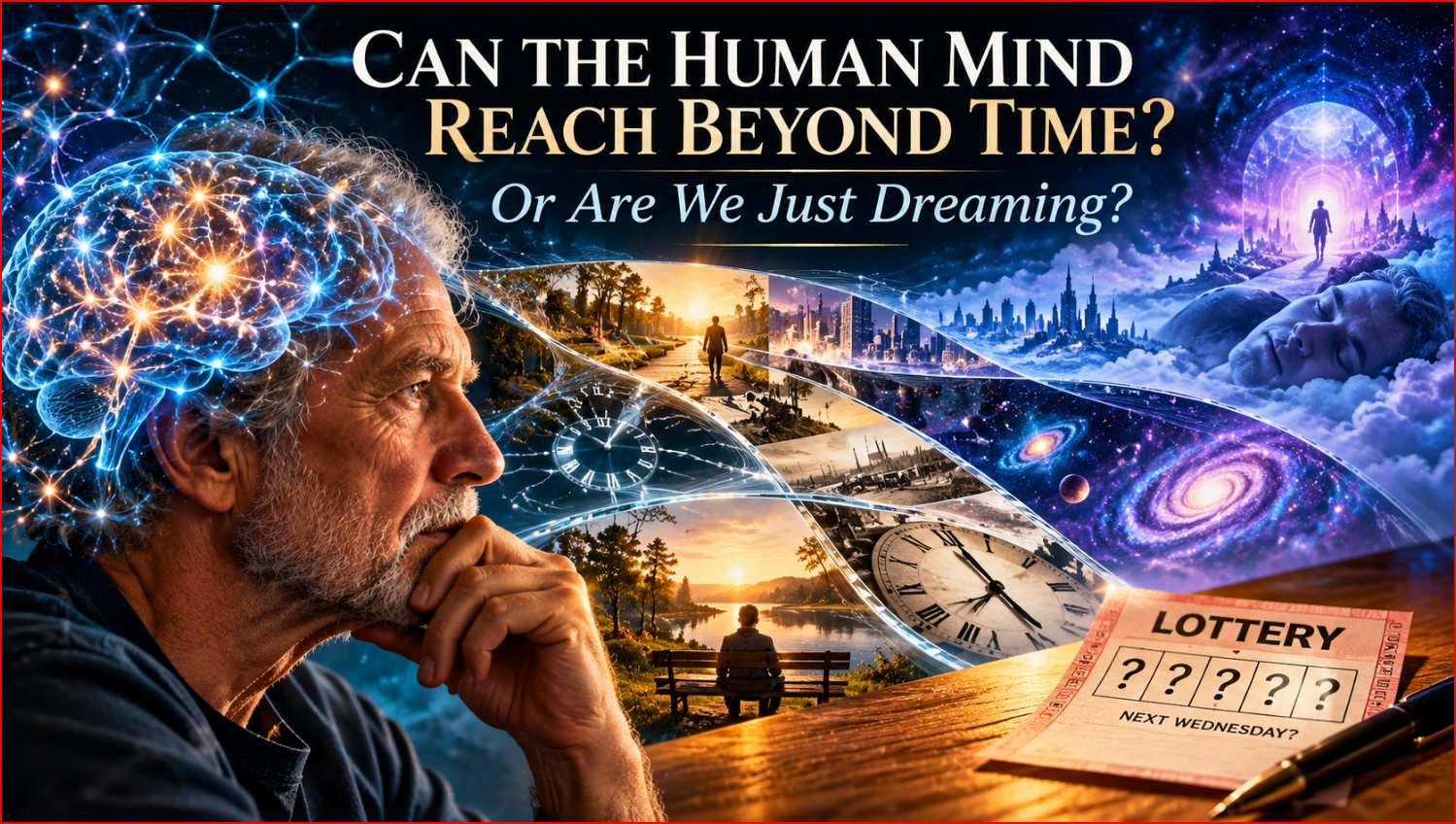
The hero illustration was generated with artificial intelligence.
Scientific Reading & Source Check
These sources support the neuroscience and research-method claims discussed above. They do not establish dream-based mind-to-mind communication, travel between timelines, or knowledge of future lottery results.
- National Institute of Neurological Disorders and Stroke — Understanding Sleep — sleep stages, dreams, and continuing questions about their purpose.
- Society for Neuroscience / BrainFacts — The Ten Percent Myth — why the notion of a dormant ninety percent of the brain is incorrect.
- National Institute of Mental Health — Magnetoencephalography Core Facility — how MEG detects extremely weak magnetic fields associated with brain activity.
- Hyperscanning: From Inter-Brain Coupling to Causality (2024) — why synchrony across recorded brains is not, by itself, proof of a causal connection.
- Quantification of Inter-Brain Coupling: A Review (2023) — methods and interpretation limits in simultaneous multi-person brain recording.