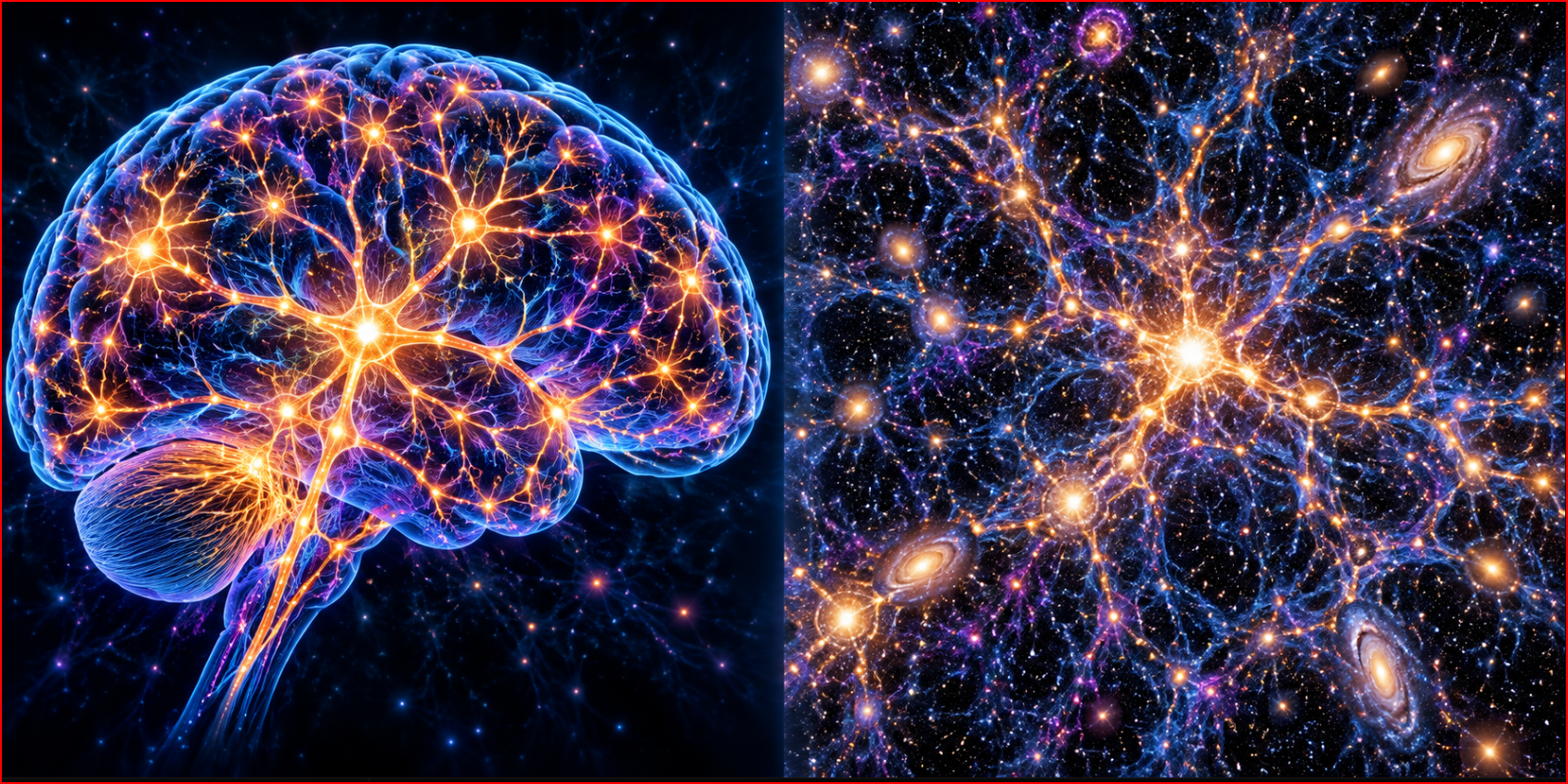
It Started With Two Pictures
Someone posted two images that caught my attention. One showed the cosmic web—the enormous network of matter and galaxies stretching across the universe. The other showed neurons in the human brain.
They looked remarkably similar. One was human. The other was almost unimaginably larger. That visual resemblance made me wonder: are we looking at something more than a coincidence?
It's an irresistible question, but an image can start an investigation without answering it.
What Are We Actually Looking At?
In the brain, neurons communicate through electrochemical signals. Their branching structures and connections form networks that help us perceive, remember, learn, and act. The appearance of those networks depends on how they are imaged and what is highlighted.
On the cosmic side, astronomers describe a large-scale structure called the cosmic web. Matter is not spread perfectly evenly through space. Gravity has helped form filaments, sheets, clusters, and vast relatively empty regions called voids. Dark matter plays a central role in the development of this structure.
The images can look alike because both show connected nodes and branching paths. But a neuron is not a galaxy, a synapse is not a cosmic filament, and the two systems operate through very different physical processes.
Why Does Nature Keep Producing Networks?
We see branching and network patterns in river systems, tree roots, blood vessels, fungi, lightning, transportation systems, and the internet. Sometimes a branching structure moves material efficiently. Sometimes a network grows through local interactions. Sometimes forces concentrate matter into connected structures.
These similarities are worth studying. They do not automatically imply that the same mechanism—or the same purpose—produced every network.
Scientists can compare patterns quantitatively, using measurements of connectivity, distribution, scale, and complexity. Those comparisons are much more informative than deciding that two pictures look alike.
Could the Universe Be Conscious?
That is the leap that makes this question so fascinating. If the universe resembles a brain, might it somehow think?
There is no established scientific evidence that the universe as a whole is a conscious brain. Nor is there an accepted demonstration that its cosmic filaments process information the way biological neural networks do.
Consciousness itself remains an active subject of research and philosophical debate. Until we can specify what would count as evidence for a conscious universe, the idea remains speculation—not a conclusion established by these images.
Resemblance is a reason to ask a question, not a reason to declare the answer.
And What About Quantum Entanglement?
Quantum entanglement describes correlations between quantum systems that cannot always be explained by treating their states as completely independent. It is real, experimentally studied physics. But it does not show that galaxies are neurons, that the cosmic web is thinking, or that everything in the universe is communicating instantaneously.
Entanglement also cannot, by itself, be used to send controllable messages faster than light. It would be a mistake to use a genuine quantum phenomenon as an unexplained bridge from an interesting image to a claim about universal consciousness.
Where Does That Leave Us?
For me, the wonder survives the correction. The universe does not need to be a giant brain for its structure to be extraordinary. And the brain does not become less remarkable because some of its branching patterns resemble structures found elsewhere in nature.
Maybe the most interesting discovery is not that the universe and the brain are the same thing. Maybe it's that nature can produce intricate networks at wildly different scales—and that one of those networks, the human brain, can look out at the others and ask why.
That's a question worth keeping open.
About This Editorial
This editorial grew from an observation and question raised by Kevin Murphy. It was developed in collaboration with Connie (ChatGPT), which assisted with research framing, writing, and editorial review. The illustration is original AI-generated artwork intended as a visual analogy, not a scientific photograph or evidence of a physical connection.
Scientific Reading & Source Check
The following institutional resources are starting points for checking the scientific background. Their specific wording and applicability must be reviewed before publication.
- NASA Science — Universe (cosmology and large-scale structure)
- NIH / NINDS — Brain and neuroscience information (neural structure and function)
- Nobel Prize in Physics 2022 (experiments with entangled photons and Bell inequalities)