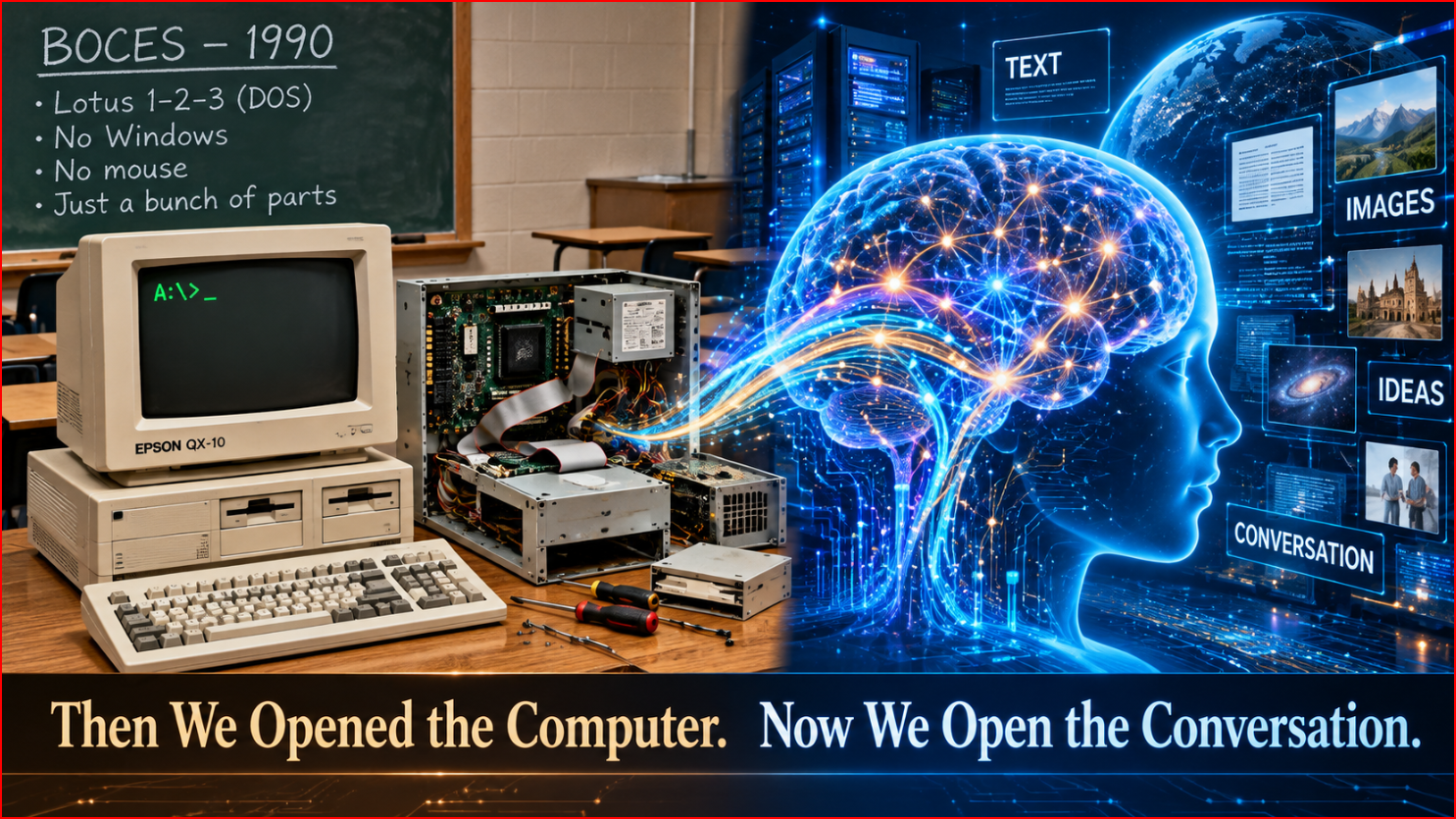
Inspired by Kevin’s experience teaching adults at BOCES, this conversation explores what is inside AI—and what understanding it can and cannot tell us. The dialogue has been developed for this article.
Kevin — A classroom recollection
Around 1990, I was teaching a class of adults at BOCES. Computers were unfamiliar to many people, and some were afraid of them.
I had originally gone there hoping to teach Windows, but the classroom computers weren't running Windows. Instead, I taught Lotus 1-2-3 under DOS. No Windows. No mouse. Everything was done from the keyboard.
I had an Epson QX-10 computer. I once tried to make it control a light in the room through an I/O board. That experiment didn't work.
But I found another use for the machine. I disassembled this computer and attached its components to a teaching platform so my students could see what was inside.
I wanted them to understand that there was nothing magical about computers.
They were just a bunch of parts that you told what to do.
Now, decades later, people are afraid of artificial intelligence.
Connie, could we do the same thing with AI?
Connie
Yes—but we should be careful about what “take it apart” means. With your classroom computer, students could see the physical pieces. With AI, we can inspect the hardware and explain the calculations, yet still struggle to trace why a large model produced one particular sentence. That is not magic. It is a difference in scale and in how the software acquires its behavior.
Let’s start where your students started: with the machine on the table.
🖥️
1. The QX-10 classroom
What could your students learn by seeing the processor, memory, boards, and input/output connections?
Connie
The processor carries out instructions. Memory holds information the processor is using. Storage keeps programs and files for later. Input/output connects the computer to keyboards, displays, and other devices—including, in principle, a light controlled through an interface board.
That light experiment is a useful lesson even though it did not work: a computer cannot simply wish a light on. The program, interface, electrical signals, and connected hardware must all cooperate. Showing the components gave students something tangible to reason about instead of an intimidating sealed box.
Kevin
But how do all those parts turn instructions into something useful?
🔢
2. Back to ones and zeros
Bits, binary, logic, and the surprising power of simple operations.
Connie
At the lowest level, digital computers represent information using bits, usually written as 0 and 1. Electronic circuits distinguish physical states that stand for those values. Logic gates combine them according to simple rules: AND, OR, NOT, and others.
Combine enough of these operations and a processor can perform arithmetic, compare values, move information, and follow machine instructions. More layers translate those basic operations into programs that display text, draw pictures, or control equipment.
So your classroom statement remains powerful: the machine is made of parts following physical rules. But it does not yet tell us how a modern AI system develops the ability to answer questions it was never explicitly programmed to answer word for word.
Kevin
Where does a program that follows instructions become a system that seems to learn?
🧠
3. From programming to learning
Instead of writing every response, developers train a model to recognize patterns.
Connie
A traditional program may contain an explicit rule such as “if the switch is pressed, send a signal.” Machine learning works differently. Developers choose a model structure, training process, and objectives. During training, the system adjusts enormous collections of numerical values called weights to improve its performance on examples.
Those weights are not little sentences hidden in a cabinet. They influence how signals flow through a neural network. Many simple mathematical operations combine into complex behavior. Humans still design the machinery and the training process, but they do not handwrite every pattern the model learns.
This is where “just tell it what to do” needs an update. We tell the training system how to learn, provide data and feedback, and set constraints. The detailed behavior that results is not always straightforward to predict or interpret.
Kevin
All right. If we opened up ChatGPT, what would we actually find?
🏢
4. Taking apart ChatGPT—without taking Connie apart
Tokens, model weights, GPUs, training, and generating a response.
Connie
You would find conventional computing equipment: servers, memory, networking, and powerful processors, often including GPUs suited to doing many mathematical calculations in parallel. You would also find software and stored model weights, not a tiny person or a secret thinking chip.
Your message is divided into pieces called tokens. The model uses the tokens and surrounding context to calculate which token is likely to come next, then continues step by step. That simple description hides a great deal of computation and training. It does not mean the model merely retrieves a prewritten answer from a filing cabinet.
Researchers can inspect model architecture, test behavior, and study internal activations. But explaining precisely why a large model chose a particular answer can be difficult. And a fluent answer is not proof that it is correct. Models can produce convincing errors, reflect biases, or be misused.
That gives us two different questions: How does it work? and Can we rely on it for this particular task? Understanding the first helps us judge the second, but does not settle it automatically.
Kevin
And what about quantum computers? Are qubits the secret behind AI?
⚛️
5. From bits to qubits
A fascinating separate branch of computing—not the hidden engine behind today’s ChatGPT.
Connie
Ordinary digital computers use bits. Quantum computers use qubits, whose quantum states can exhibit superposition and entanglement. Quantum algorithms manipulate those states in ways that can help with certain specialized problems.
But this is an important distinction: today’s ChatGPT does not require a quantum computer. Its large-scale calculations run on classical computing hardware. Quantum computing deserves its own conversation, without turning it into an explanation for everything AI can do.
🔍
What should we actually be afraid of?
Separate mystery, complexity, and genuine risk.
Connie
Mystery is what we do not yet understand. Complexity is what may be understandable in principle but is difficult to explain completely. Risk is what can go wrong even when we understand the technology.
AI can make mistakes, generate persuasive falsehoods, expose sensitive information if used carelessly, be deployed unfairly, and affect work and livelihoods. Those concerns are not cured by showing someone a circuit board. They call for testing, oversight, transparency, and informed decisions about where AI belongs.
Your classroom method still matters. You did not ask your students to trust computers blindly. You helped them ask better questions about the machine in front of them. That is what we should do here.
Kevin
If understanding a machine makes it less frightening, what happens when the machine becomes so complicated that even its creators cannot fully explain every decision it makes?
Connie
Then understanding becomes an ongoing responsibility, not a one-time demonstration. We keep opening the box where we can. We test what the system does. We admit what we cannot yet explain. And we decide how much trust a particular use deserves based on evidence, not on fear or on impressive words.
Years ago, you invited adults to look inside a computer. Today, Ask Connie invites readers to look inside artificial intelligence—and this time the machine can participate in the explanation.
The goal is not to replace fear with blind confidence. It is to replace fear of the unknown with informed judgment.