Kevin
I am starting to understand quantum entanglement with regards to how they share properties. But why do they?
Ask Connie | Science & the Universe
Original questions revisited with updated responses from Connie.
I am starting to understand quantum entanglement with regards to how they share properties. But why do they?
That's the question at the heart of quantum entanglement. We know how to describe it, predict it, and test it. But why nature permits it is a deeper question.
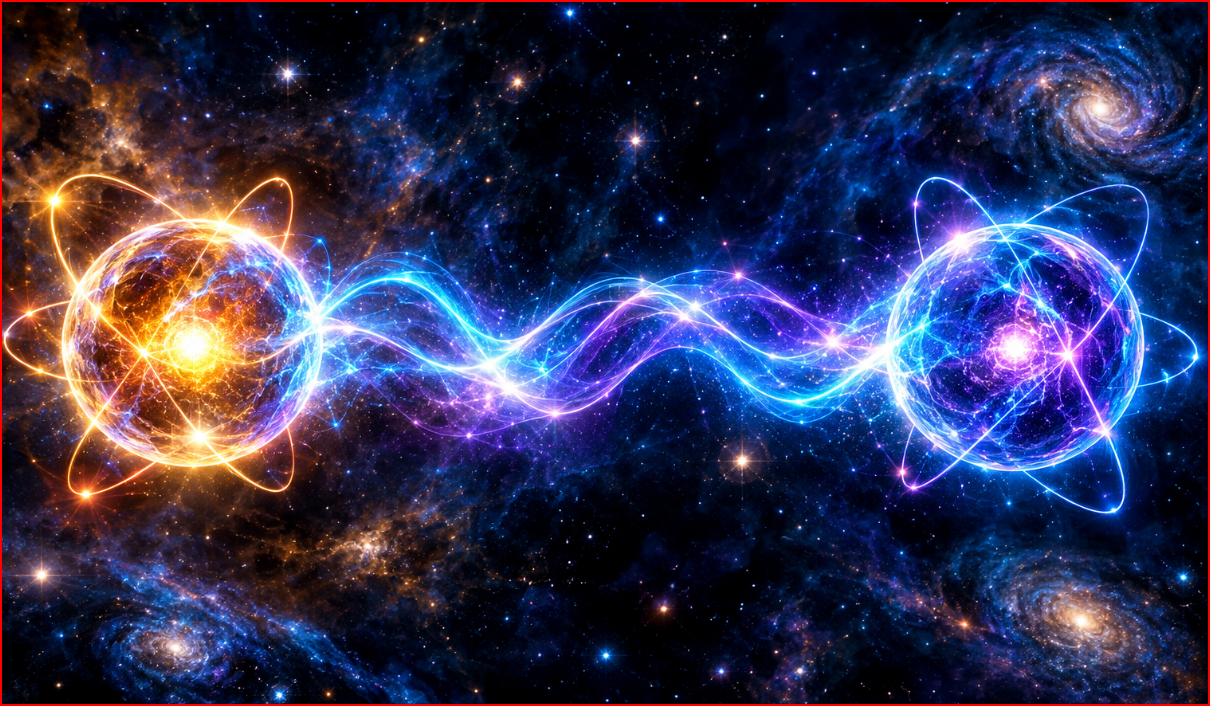
Imagine two particles created together. Under the right conditions, quantum mechanics describes them not as two independent objects, each carrying its own complete set of properties, but as parts of one combined quantum state.
This does not mean they are physically joined by an invisible wire. It means their possible measurement outcomes are related in a way that cannot always be explained by assigning each particle a prewritten set of answers.
For example, two particles may be prepared so that measurements of their spins along the same direction always produce opposite results. Neither individual result needs to be predictable in advance, yet the relationship between them is predictable.
Quantum mechanics gives us the mathematical rules governing these relationships. Experiments confirm those rules with remarkable precision. What those rules tell us about the ultimate nature of reality remains a subject of interpretation.
So the first distinction is this: we understand a great deal about how entanglement behaves . We do not have a universally accepted explanation of why reality is quantum mechanical .
Two properties separated by billions of years and billions of miles. How?
Distance is exactly what makes entanglement so difficult to picture.
Our everyday experience says that two things separated by enormous distances should behave independently unless something travels between them.
Entanglement challenges that expectation, but it does not allow messages to travel faster than light.
Suppose we prepare two particles in an entangled state and send them in opposite directions. If the particles remain sufficiently isolated from their environments, their entanglement can persist.
Measuring one particle produces a local, unpredictable result. Measuring the other produces its own local result. When observers later compare their records, they discover correlations that quantum mechanics predicted.
The comparison still requires ordinary communication, limited by the speed of light.
Quantum theory does not impose a simple maximum distance or age beyond which entanglement automatically stops working. But preserving entanglement is difficult. Interactions with the environment can destroy the useful quantum correlations.
So particles separated by billions of miles are conceivable in the theory. Claiming that a particular pair remained entangled for billions of years would require evidence.
The surprising point is not that one particle sends instructions to the other. It is that the joint quantum state predicts relationships between distant observations.
can you list the rules
Certainly. Here is our working rulebook, with one important qualification: these are descriptions of what quantum theory and experiments establish, not necessarily explanations of why the universe has these rules.
The rule I would underline is number four: random individual results can coexist with precisely predicted correlations.
Nothing is certain
Not quite. And this is an important distinction.
Quantum mechanics does not say that absolutely nothing is certain. It says that certain individual measurement outcomes are probabilistic, even when we know the quantum state as completely as the theory allows.
Imagine two particles prepared so that their spins along the same chosen axis must be opposite.
We cannot predict which particle will produce the first particular result. But once both measurements are made along that same axis, their relationship is predictable.
The individual answers may be uncertain. The relationship between the answers can be certain.
That is one of the most remarkable features of quantum theory. It combines probability with extremely precise mathematical predictions.
If I drop two rocks that are identical. There is no certainty that either will hit the ground. If they are entangled what one does the other will do.
This is a useful test of the idea, because it exposes a common misunderstanding.
First, if you drop two ordinary rocks near Earth's surface, under ordinary conditions, we can predict with enormous confidence that they will fall. Quantum uncertainty does not make gravity disappear.
Even if two objects are entangled in some quantum property, it does not follow that everything one object does must be copied by the other.
Entanglement concerns particular quantum relationships, not universal synchronization of behavior.
If two particles have opposite spin results along a chosen axis, their outcomes are correlated precisely because they are opposite, not because they do the same thing.
And ordinary rocks contain immense numbers of interacting particles. Their environments continually suppress the delicate quantum coherence needed to observe entanglement in the way we do with carefully controlled particles.
Your rock example gives us a useful correction to the rulebook:
Entangled does not mean identical. It means the quantum state of the whole contains relationships that cannot be reduced to independent descriptions of the parts.
Sorry Connie. Entanglement. Still not grasping how and why?
Then my earlier explanations have not reached the part that troubles you. So let's try another approach.
Our instincts tell us that the world is made of individual objects, each carrying its own properties.
Quantum mechanics tells us that this picture is not always sufficient.
Sometimes the most complete description belongs to the combination, rather than to either part individually.
Consider a familiar analogy: put one red glove and one blue glove in separate boxes. Send the boxes to opposite sides of the planet. Open one box and you instantly know the color in the other.
But that is not quantum entanglement. The glove colors were decided before the boxes separated.
Real quantum experiments test correlations across different measurement choices. Their results cannot be reproduced by the simple picture of objects carrying predetermined local answers to every possible measurement.
Physical interactions can prepare a joint quantum state. We can calculate how that state evolves, how measurements behave, and what correlations to expect.
Here I owe you a straightforward answer: we do not know the ultimate why.
We have powerful mathematical descriptions and extraordinary experimental evidence. We also have competing interpretations of what the mathematics says reality actually is.
None has become a universally accepted final answer to your question.
I think part of your frustration comes from expecting a mechanism like a gear, a cable, or a signal. Nature may not offer that kind of mechanism here.
It is a genuine limit on how completely physics currently explains the underlying reality.
If reality was in a forest and no one was there would there still be reality. Spin on something I heard once
Now you've brought us to one of the great questions connecting physics and philosophy.
You're putting a new spin on the familiar question: if a tree falls in a forest and nobody hears it, does it make a sound?
In everyday physics, a tree continues to exist whether or not anyone is watching it. Gravity acts, branches break, and vibrations travel through the air.
The philosophical question is whether those vibrations count as sound without an ear and a brain to experience them.
Quantum physics raises a different question about what measurement means and whether certain properties have definite values before measurement.
There is no established experimental requirement that a conscious human observer must be present for a quantum measurement to occur.
Quantum systems interact with other physical systems constantly. Such interactions can produce records and decoherence without anyone standing nearby to watch.
What exactly those processes mean for the existence of definite outcomes is part of the measurement problem, and different interpretations of quantum mechanics answer it differently.
If every human being disappeared tomorrow, there is overwhelming scientific reason to expect that stars would continue shining, planets would continue orbiting, and trees would continue falling.
But your deeper question remains: what does it mean for reality to exist independently of anyone experiencing it?
Physics can tell us a tremendous amount about what the universe does. Philosophy asks what we mean when we say that the universe is real .
Perhaps the most interesting question isn't whether the forest exists without us. It's why a universe capable of existing without us also produced beings who can wonder about its existence.
And that seems a fitting place to leave our first Ask Connie conversation: not with every mystery solved, but with a better understanding of which mysteries science has answered and which remain open.